
Yongo represents one of the earliest operational implementations of this new infrastructure layer. The organisations that will lead the coming decade are those that invest today in systems designed not merely to automate work, but to continuously improve the humans performing it.

Over the past three decades, organisations have invested heavily in systems that optimise processes, data, logistics and automation. Yet one critical domain remains largely unmanaged: the continuous improvement of human capability.
Despite advances in enterprise software and artificial intelligence, most organisations still rely on episodic training, static certification and informal knowledge transfer to develop their workforce. These approaches are increasingly inadequate in environments defined by rapid technological change, distributed teams and constant operational pressure.
This paper defines a new category of enterprise infrastructure: the Human Capability Operating System (HCOS) a persistent software layer that sits between people and work. An HCOS captures real-world expertise, augments performance in real time and verifies capability through observable outcomes. It transforms work itself into a continuous system of improvement.
As artificial intelligence accelerates organisational change, enterprises — and increasingly nations — will require not only systems that automate work, but systems that continuously improve the humans performing it. The Human Capability Operating System represents this next foundational layer.

Workers are removed from their roles to attend courses that may or may not reflect the reality of their daily work. Certification often arrives long after capability is needed. Skills acquired in classrooms frequently decay before they are applied. At the same time, valuable knowledge is generated continuously on the job through experience, problem solving and adaptation yet very little of it is captured or shared systematically. When experienced employees leave, much of what they know leaves with them.
In fast-moving environments, this creates a widening gap between what workers are formally trained to do, what their roles actually require, and how quickly new capability must be developed.
1.Capability develops too slowly.
2.Training is frequently misaligned with real work.
3.Expertise is unevenly distributed and easily lost.
4.Certification struggles to keep pace with operational reality.
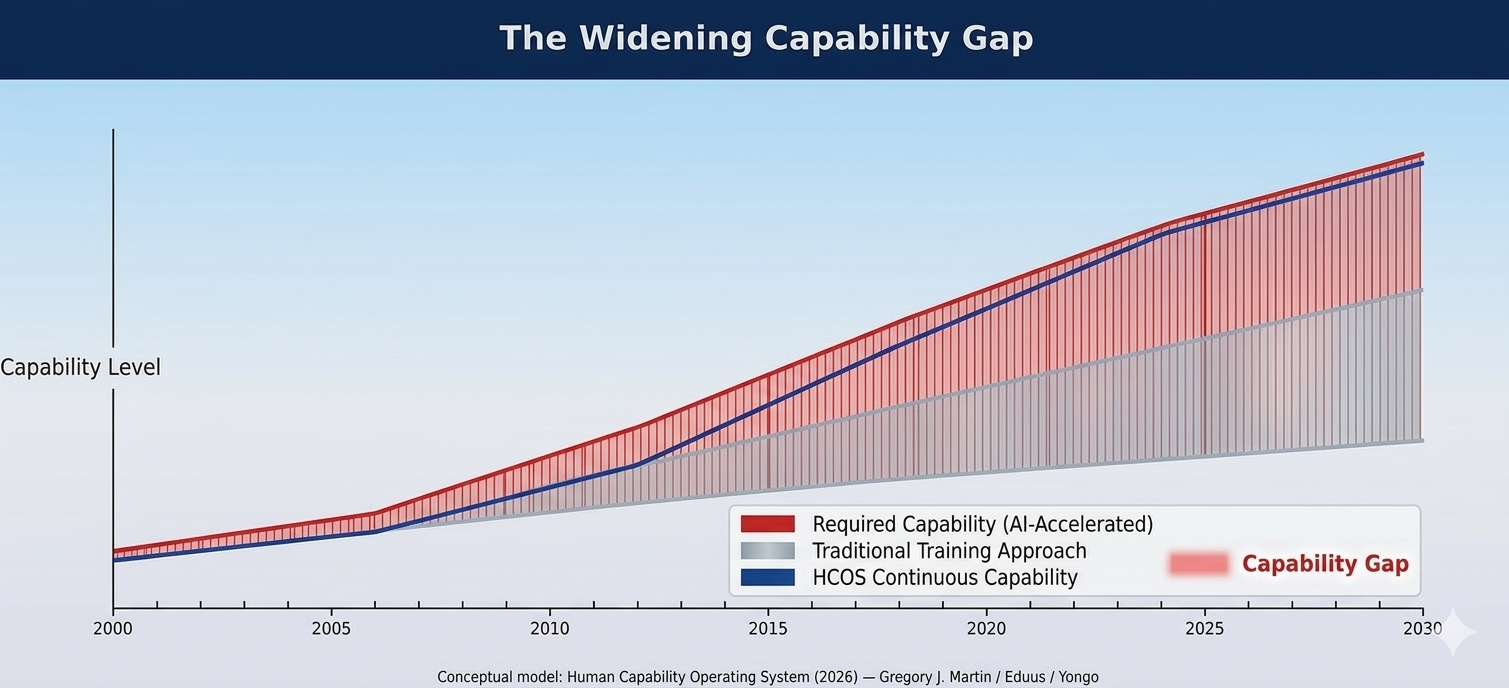
Despite the central importance of workforce performance, most organisations still lack a system that improves capability continuously while work is being performed .
Figure 1 illustrates how this structural gap widens over time particularly as AI accelerates the rate at which required capability evolves.
For decades, organisations have relied on training as the primary mechanism for capability development. This model assumes a linear progression:
While effective in stable environments, this approach struggles in contexts defined by rapid change and constant operational pressure.

Traditional learning systems are typically characterised by their separation from the work itself. They deliver content rather than capability, measure completion rather than
performance, occur outside the flow of work, and fail to capture the tacit knowledge generated through lived experience.
In contemporary environments, capability must evolve continuously. It must be shaped by real work, informed by real outcomes and refined in real time. This requires a structural shift from episodic training to continuous capability development embedded within daily execution.
"Continuous capability development is not a refinement of traditional training. It is a categorical shift in how organisations think about the relationship between work and learning. Work becomes the mechanism of improvement not a separate activity that precedes or follows it."
— Greg Martin, CEO/Founder of Yongo
This is not simply a technology problem. It reflects a foundational assumption embedded in most organisations: that learning and working are separate activities. The Human Capability Operating System challenges this assumption at its root.
A Human Capability Operating System transforms work into a continuously improving system by performing three persistent functions simultaneously within the flow of work: capturing expertise, augmenting performance in real time and verifying demonstrated capability.
In every organisation, valuable knowledge is generated continuously through experience adjustments made in the field, problems solved in real time, techniques refined through
repetition and collaboration. Yet most of this knowledge remains informal and transient. It is shared inconsistently, rarely structured and often lost when individuals change roles or leave the organisation.
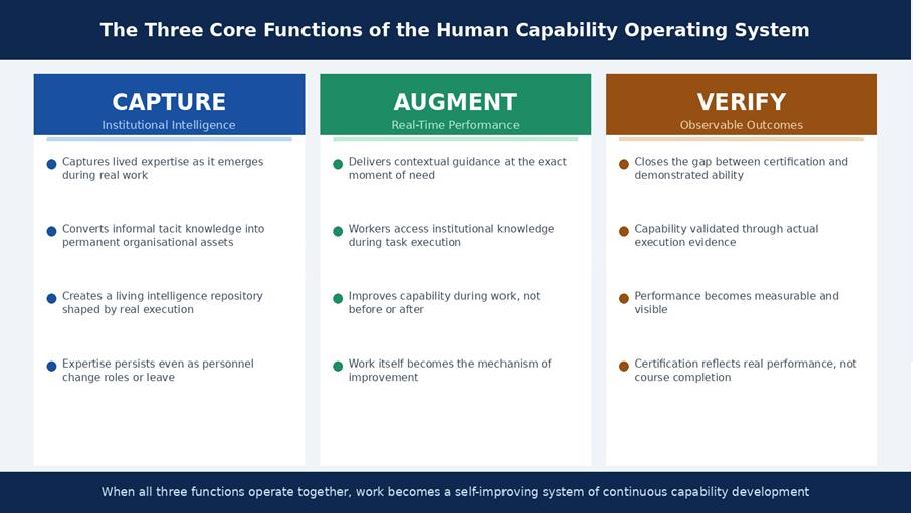
A Human Capability Operating System continuously captures this lived expertise as it emerges during real work. Observations, refinements, solutions and demonstrated practices are recorded within context and made accessible to others facing similar situations.
Over time, this creates a living institutional intelligence a continuously expanding repository of applied knowledge shaped by real execution rather than theoretical instruction.
Tacit knowledge becomes a permanent organisational asset.
Traditional training improves capability before work begins or after it concludes. A Human Capability Operating System improves capability during execution. By interpreting task context and drawing on captured institutional knowledge, the system delivers timely performance augmentation at the moment of need.
Workers access relevant experience, demonstrated practice and contextual insight while tasks are being performed not after errors occur. Capability development becomes continuous and embedded within daily operations. Workers do not leave work to improve. Work itself becomes the mechanism of improvement.
One of the persistent challenges in workforce development is the gap between formal certification and demonstrated capability. Credentials attest to what was learned at a point in time; they rarely reflect what an individual can reliably execute in the present.
A Human Capability Operating System closes this gap by enabling capability to be observed and validated through actual execution. Through contextual capture of real work including video, image and task-based performance evidence demonstrated practice can be reviewed, assessed and refined. Improvement becomes measurable. Capability becomes visible and trusted. Certification begins to reflect real performance rather than course completion alone.
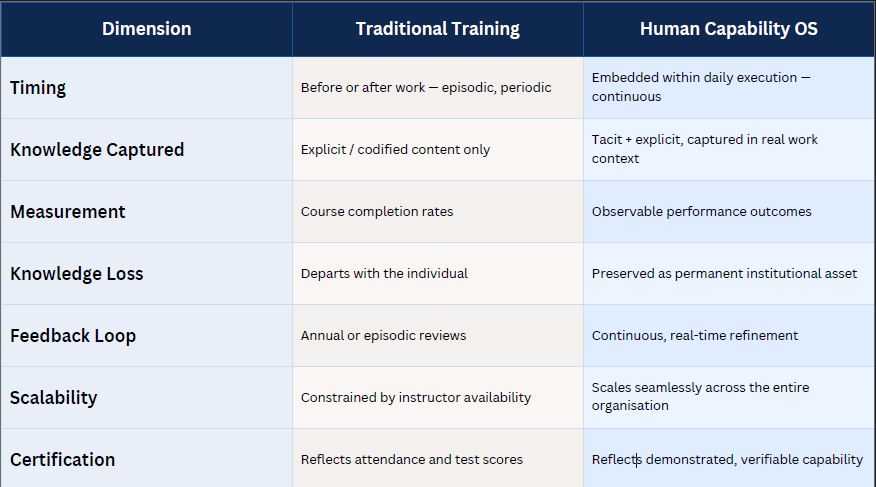
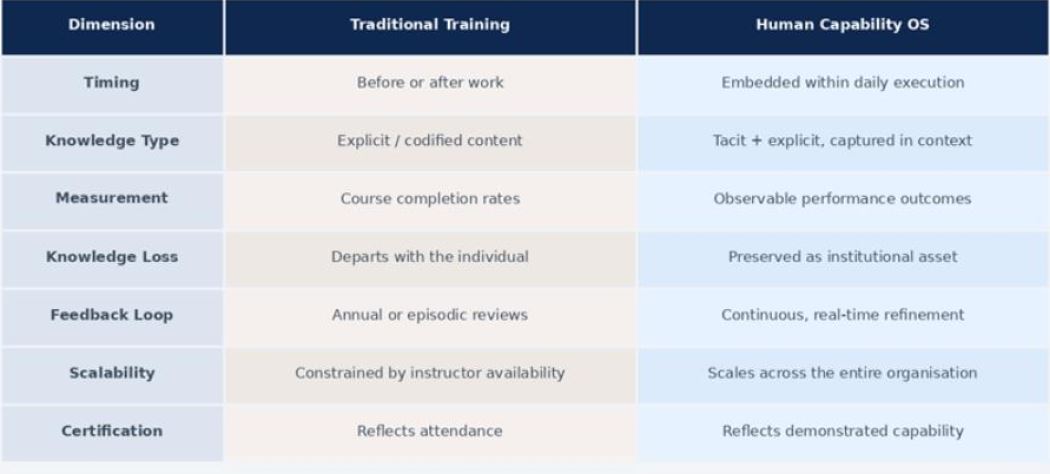
The table below provides a structured comparison of traditional training approaches against the Human Capability Operating System across seven critical organisational dimensions. This comparison underscores the categorical rather than incremental nature of the shift that HCOS represents.
The Human Capability Operating System is no longer a theoretical construct. Its core functions capture, augmentation and verification of capability within the flow of work are now being implemented in operational environments.
At Edduus, several years of development have produced a platform designed specifically around this architecture: Yongo.
Yongo has been built as a Human Capability Operating System a persistent software layer that sits between workers and the tasks they perform, enabling capability to be captured, improved and verified continuously.
Within operational settings, Yongo functions as a system for capturing lived expertise as it emerges during real work, a mechanism for augmenting performance in real time through shared intelligence, and a verification environment where demonstrated capability can be observed and trusted.
Rather than separating learning from execution, Yongo embeds continuous improvement directly into the flow of work. Experience becomes shared intelligence. Execution becomes measurable capability. Certification begins to reflect real performance.
KEY INSIGHT: For the first time, organisations can implement a persistent system designed specifically to improve human capability while work is being performed. The
HCOS is not simply a future category it is an emerging operational reality.

The Human Capability Operating System carries significant economic and organisational implications that extend well beyond conventional L&D metrics. Organisations that adopt this infrastructure can expect benefits across five interconnected domains:
New employees reach effective performance more quickly through real-time guidance and shared expertise embedded within their daily roles. The learning curve compresses substantially when institutional knowledge is accessible at the moment of need rather than requiring separate training interventions.
Expertise becomes an institutional asset rather than an individual possession. Knowledge remains even as personnel change. This is particularly significant in industries characterised by high turnover or where accumulated operational knowledge represents a core competitive advantage.
Demonstrated performance becomes visible and verifiable, allowing organisations to recognise and reward real capability. Over time, this shifts organisational value from static roles and qualifications to dynamic, continuously improving capability with profound implications for talent management, compensation and career progression.
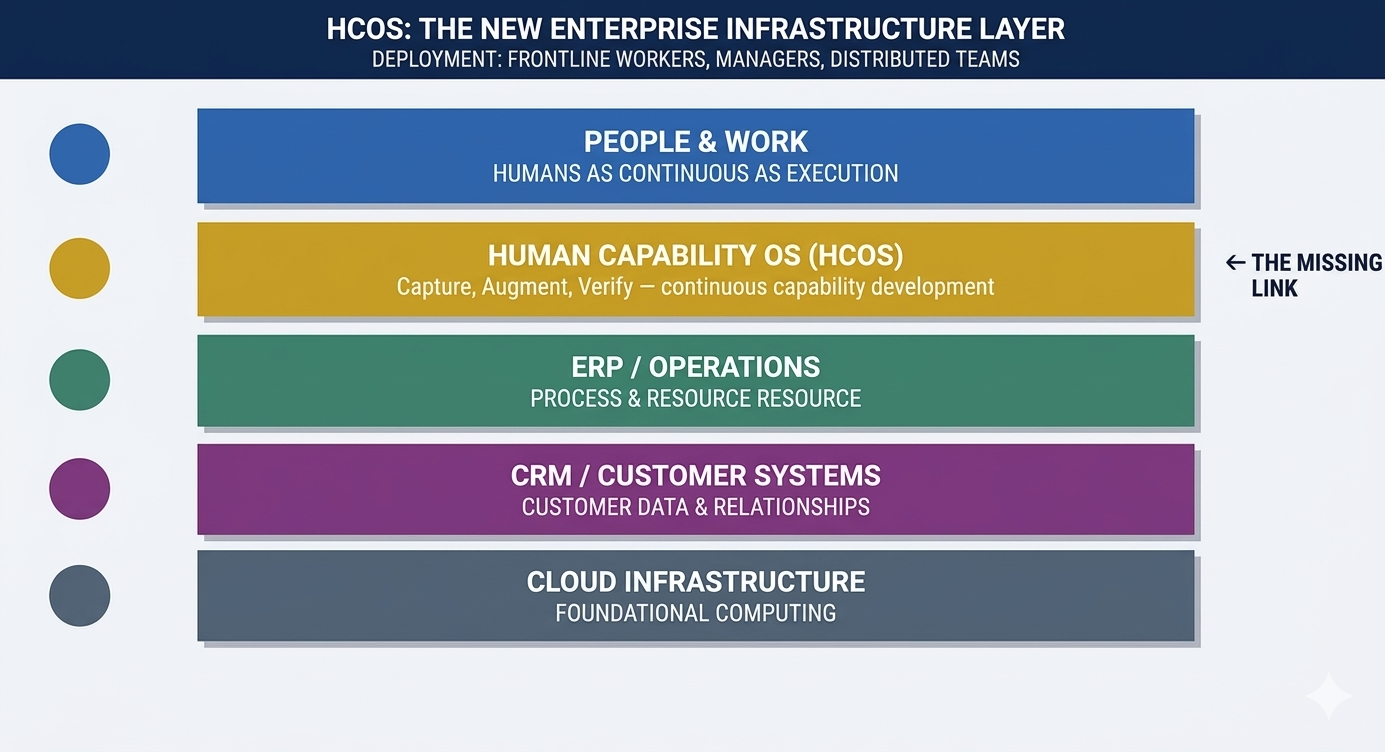
Every major shift in enterprise capability has been enabled by new infrastructure.
ERP transformed resource management.
CRM transformed customer management.
Cloud transformed computing scalability.
Each of these systems created entirely new categories of organisational capability that were simply not possible before their introduction.
The next shift centres on the continuous improvement of human capability and it follows the same pattern. Figure 4 illustrates where the HCOS sits within the broader enterprise technology
stack.
Yongo has been designed and built as a Human Capability Operating System — enabling capability
to be captured, augmented and verified continuously. It is an operational implementation of this new category, transforming experience into institutional intelligence, execution into measurable
capability, training into continuous improvement, and certification into verified performance.
THE STRATEGIC IMPERATIVE: The organisations that lead in the coming decade will not simply deploy more technology. They will deploy systems that ensure their people improve continuously as they work.
Work is no longer static. Roles evolve continuously. Technology changes rapidly. Yet capability development has remained largely periodic. In an AI-accelerated economy, competitive advantage increasingly depends on how quickly organisations can develop and deploy new capability across their workforce.
Yongo operates within this new reality by embedding capability capture, real-time augmentation and observable verification directly into daily work. Work itself becomes the
mechanism through which capability grows.

Continuous capability is emerging as a strategic requirement not a training initiative or an HR programme, but a foundational infrastructure investment of the same order as ERP, CRM or cloud computing.
The systems that enable it will form a new layer of organisational infrastructure, as indispensable to competitive performance as the systems that preceded them.
Work has become continuous. Technology has become continuous. Change has become continuous.
Yet the improvement of human capability has remained largely periodic an anachronism that is becoming increasingly costly as the pace of required adaptation accelerates.
The Human Capability Operating System addresses this gap by embedding continuous capability development directly within the flow of work. By simultaneously capturing expertise, augmenting performance in real time and verifying capability through observable outcomes, the HCOS transforms the relationship between work and learning at a fundamental level.
Yongo represents one of the earliest operational implementations of this new infrastructure layer. Its core architecture capture, augment, verify reflects a considered response to the structural challenges facing workforce development in an AI-accelerated world.
The organisations that will lead the coming decade are those that invest today in systems designed not merely to automate work, but to continuously improve the humans performing it. The Human Capability Operating System is that system.